
.png)
Sunday Night Sings

Originally posted online: February 18, 2017
Each summer of my growing-up years, my family spent the month of August at our cottage on Kahshe Lake in Ontario, Canada. My father, Bob Crocker’s family had been spending much of each summer on this beautiful northern lake since 1910, the year that my great-grandfather traveled to the lake from Toronto and built one of the first cottages. The family gathered at Bona Vista, the cottage built on a rocky point overlooking the lake.
A family tradition began at Bona Vista as three generations of the Crocker family joined together for the morning meal on the large screened-in porch. A hymn was sung as a blessing. Enjoying the singing together, it was suggested that the singing continue after breakfast devotions as well. The tradition of “the sing” had begun. The sing expanded beyond the family when neighbors across the cove heard the singing and wanted to join in. Then the morning sing changed to a Sunday evening sing. “God Who Touchest Earth With Beauty” was the hymn that always closed the Bona Vista sing. As the family grew too large for Bona Vista, family members, including my father, purchased other pieces of property around the lake.
The sing was no longer just held at Bona Vista, but the sing expanded out to other cottages on the lake. What had begun as a hymn sing had also changed to include folk songs and camp songs, largely because of the influence of my Aunt Geri, who was an accomplished leader of folk songs. And the circle of families continued to expand as well. Families invited from the States for visits fell in love with the lake and bought cottages. And friendships with Canadian families widened the community, which became known to us all as “the gang.” Hail, hail, the gang’s all here. The Sunday night sings of my childhood summers were greatly anticipated each week. Because we didn’t have phones in the early years, the message of where the sing was to be held would have to be delivered in person by boat, traveling to all the cottages. This was a job we always loved because it gave us an excuse to take out the boat and visit friends.
When the gang arrived for the sing, boats were tied to the docks, boats were pulled onto the beach, and some boats were tied to other boats, so you had to step from one to another to finally step onto the dock. As many as 50-60 people might be at the sing. The sings began with supper. Everyone brought sandwiches, and the host family provided the drinks and cookies. Circling the food tables searching for sandwiches that were more interesting than our own family’s same old boring ones was part of the sing excitement. With food balanced on paper plates and drinks of Kool-Aid, the kids perched on the rocks to eat with siblings, cousins, and friends before the singing began. The sings were often held outside because many of the cottages were not large enough for such a huge crowd. Then a campfire could be built, and we could enjoy the view of the sunset on the lake. Mosquitos were the drawback to this arrangement, however. But when it was at our place, we had enough room with people filling benches and kids sitting in the loft overhead with feet dangling through the loft railing. Many of the men were Methodist ministers. They and their families were used to singing in the church and at church camps, so our sings had singers who sang with great enthusiasm.
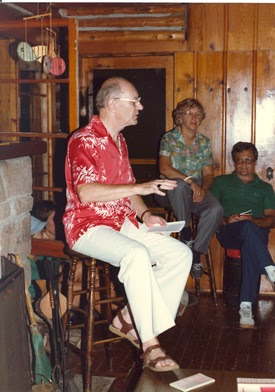
My father directed the singing at our place, but other people directed songs that were their specialties, such as Kermit Long’s big stick/little stick version of “My Bonnie Lies Over the Ocean.” We usually began with hymns, but with the prodding of the kids, we eventually sang “the fun songs.” Often, we divided into groups to sing rounds such as “Let Us Sing Together,” “Dona Nobis Pacem,” and “Oh, How Lovely is the Evening,” to name just a few. I always loved the rounds because of the beautiful harmonies that developed. We sang songs with hand and body motions like “Old King Cole” and “Alouette.”
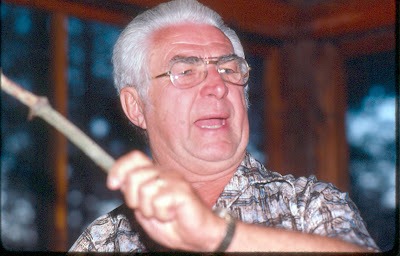
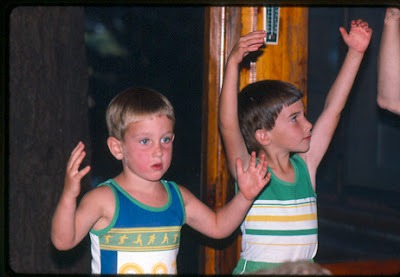
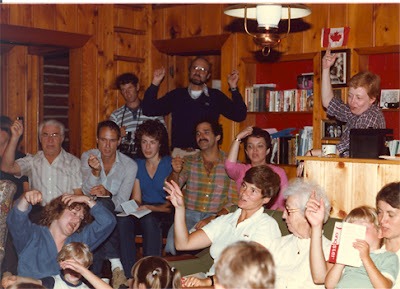
There were songs which were special for our shared experience of the lake, like “The Canoe Song” with its verse “our paddles keen and bright, flashing with silver, follow the wild goose flight, dip dip, and swing” and the song which expressed our love for the lake, “Hail, Dear Lake Kahshe.” People were always encouraged to bring a new song to teach to the gang, and they did. Songs came from across the United States and Canada to become a part of the Sunday Night Sing. As kids, we sang these songs, not just at the Sunday night sings, but whenever we went on our excursions around the lake. Strains of the song “The Orchestra,” with harmonies provided by each of our voices singing the part of a different instrument, could be heard across the water in the evening as we came back from gatherings with friends. The songs followed me into my adult life when I became a teacher and taught many of them to my students. Our Sunday night sings have continued through the years, though the numbers have been much smaller each summer than during my childhood.
The last sing at our cottage was in 1999 when we celebrated my parents’ 80th birthdays. It was attended by 90 people, including four generations of our family. A videotape of this evening is a wonderful record of our family sing tradition. In the spring of 2005, my parents, sister Sue, and I visited my Aunt Geri, who had introduced folk songs to the family sing many years before. She was 94, suffering from Alzheimer's, and living in an assisted living home in Maryland. She recognized my father, but we weren’t sure how much she understood of the conversation. My father told stories of their past adventures, and she seemed to show some recognition and remembrance. And then I suggested that we sing some of our Kahshe songs, which had been so much a part of her life. So we began to sing, one song leading into another. She sang each song with ease, remembering each note and word. Her hands moved with the motions, and she led as the director she had once been. What pleasure we shared.
In August 2007, a sing was held at Kahshe Lake on my Aunt Geri’s porch. It was a part of a memorial service for her. My cousin Dave led us in singing a few of the songs that were favorite ones which my aunt had led. We sang as a celebration of her life. In July 2012, many of our “Kahshe Gang” gathered in Illinois for the memorial service of my father, Bob Crocker. At the conclusion of my speaking about Dad’s life of 93 years on Kahshe Lake, we all joined together at the front of the sanctuary to sing “Hail, Dear Lake Kahshe.” We sang as a remembrance of him and our shared love for Kahshe and with a strong awareness of our shared sing tradition reaching back 100 years.

***
The Healing Waters of Kahshe Lake — With thanks to Clare Henderson, this story first appeared on his Healing Waters blog and continues the tradition of his cherished book series, The Healing Waters of Kahshe Lake. In conjunction with the Conservation Committee, Clare also helped curate The Kahshe Lake Archive — a growing collection of letters, maps, documents, diagrams, and historical photographs that illuminate the lake’s rich past. His dedication to preserving the spirit and history of Kahshe Lake has made this living archive possible. To keep the tradition alive, we invite you to share your own cottage stories and memories — and help carry on Clare’s work in celebrating the legacy of life on Kahshe and Bass Lakes.